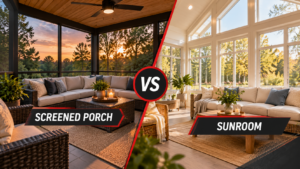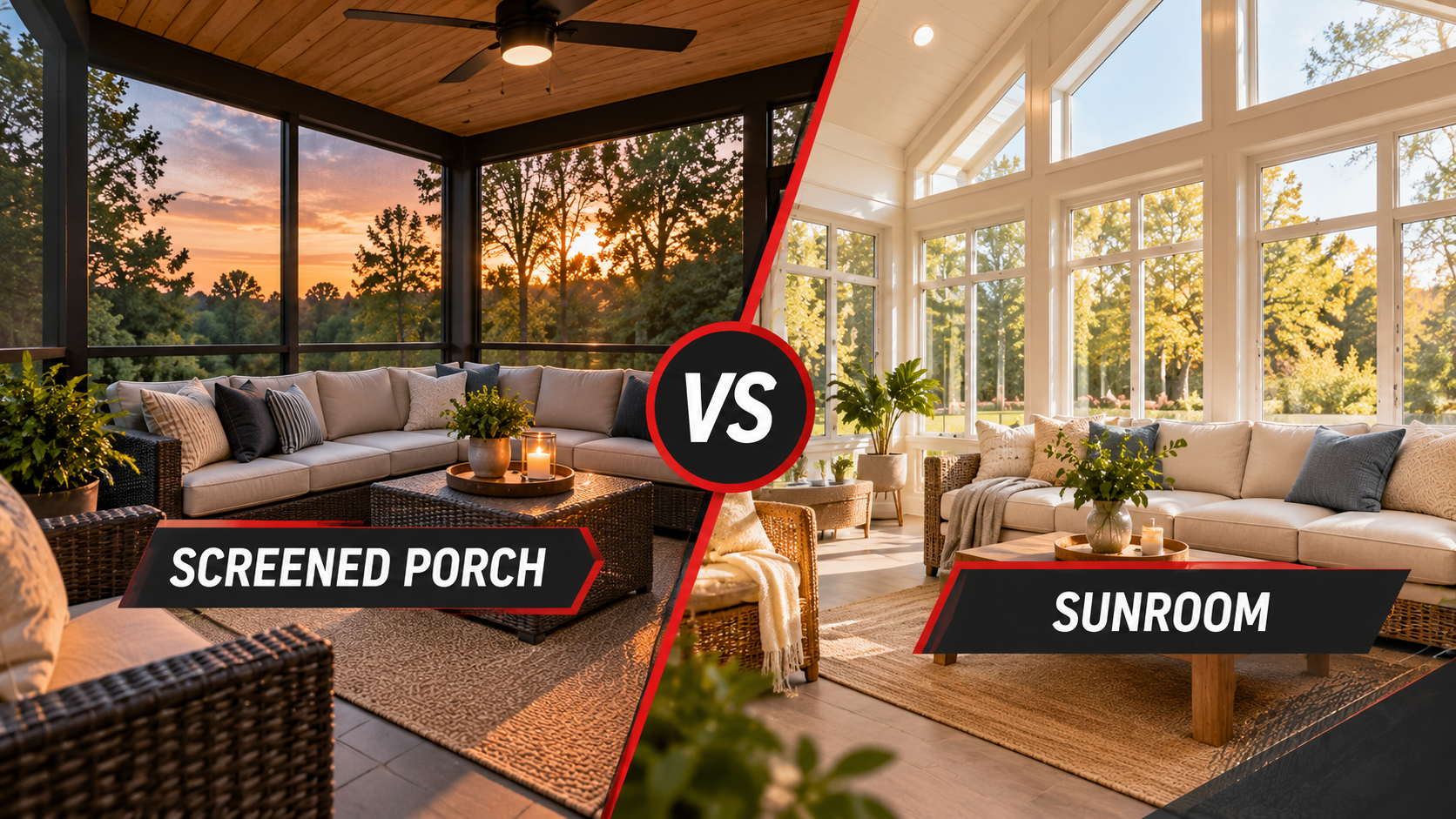
Imagine sitting outside on a warm evening without dealing with mosquitoes.
Now imagine being able to enjoy that same space on a chilly morning, during a light rain, or in the middle of winter.
That is where the difference between a sunroom and a screened porch becomes important.
Both can expand your living space and create a stronger connection to the outdoors. But they are designed for different levels of protection, comfort, and year-round use.
So when comparing sunroom vs screened porch, the right choice depends on how you want to use the space, how much protection you need from weather and insects, and whether you want something closer to an outdoor room or an extension of your home’s interior.
Key Takeaways
- A screened porch provides an outdoor experience with protection from insects and some weather.
- A sunroom is more enclosed and can function much more like an indoor living space.
- Four-season sunrooms are designed for greater year-round comfort than traditional screened porches.
- Neither option is automatically better; the right choice depends on your lifestyle, home, climate, and budget.
- Planning the structure around how you will actually use it is more important than simply choosing the most elaborate option.
Sunroom vs. Screened Porch: What’s the Basic Difference?
The easiest way to understand the difference is to look at the level of enclosure.
A screened porch generally has screened openings that allow fresh air to move through the space while helping keep insects outside.
A sunroom is more enclosed, typically using substantial windows or other glazed openings to provide a brighter indoor-like environment while maintaining views of the outdoors.
Think of the progression like this:
Open patio → Screened porch → Sunroom → Indoor living space
A screened porch sits closer to the outdoor side of that spectrum.
A sunroom sits closer to the indoor side.
That distinction affects comfort, weather protection, furniture choices, maintenance, and how often you can realistically use the space.
What Is a Screened Porch?
A screened porch is an outdoor living area protected by screening rather than traditional walls and windows.
The screens allow air to circulate while creating a barrier against many insects.
For homeowners who love sitting outside but dislike bugs, this can be a significant advantage.
Screened Porch Benefits
A screened porch can provide:
- Fresh airflow
- Protection from many insects
- A more open outdoor feeling
- A comfortable place for casual seating
- Space for outdoor meals
- A transition between the house and backyard
It can be especially appealing during comfortable seasons when the goal is to feel like you are outside without dealing with mosquitoes and other pests.
What Is a Sunroom?
A sunroom is a more enclosed structure designed to bring natural light and outdoor views into a protected living area.
Large windows are often a major part of the design.
Depending on the construction, insulation, windows, heating, and cooling, a sunroom can function much more like an extension of the home’s interior than a traditional porch.
This gives homeowners additional flexibility.
You could use the room as:
- A sitting room
- A breakfast area
- A reading space
- A family lounge
- A home office
- A hobby room
- An entertainment area
The exact possibilities depend on the way the addition is designed.
What Is a Four-Season Sunroom?
A four season sunroom is designed with greater insulation and climate control considerations so the space can be used more comfortably throughout the year.
That can make a major difference for homeowners who do not want their new space to become unusable once temperatures become too hot or too cold.
A four-season design may include features such as:
- Insulated walls
- Energy-efficient windows
- Insulated flooring
- Heating
- Air conditioning
- More substantial construction
This generally makes the space feel more like a true extension of the home.
A traditional screened porch, by comparison, remains much more exposed to outdoor temperatures.
Screened Porch vs. Sunroom: How Do They Compare?
The best way to compare them is by thinking about how you expect to use the space.
| Feature | Screened Porch | Sunroom |
| Insect protection | Excellent | Excellent |
| Fresh-air feel | High | Lower |
| Weather protection | Moderate | Higher |
| Year-round comfort | Limited | Greater |
| Connection to outdoors | Very strong | Strong through windows |
| Indoor-like environment | Limited | Stronger |
| Furniture flexibility | Outdoor-focused | More indoor-style options |
| Climate control | Usually limited | More practical |
| Best for | Seasonal outdoor living | Extended or year-round living |
These are general characteristics, and the final performance depends on the design and construction.
Sunroom Benefits: More Than Just Extra Windows
One of the biggest sunroom benefits is the ability to create an indoor-like environment while maintaining a strong visual connection to the outdoors.
You can enjoy the backyard without sitting directly in it.
That can be especially appealing when you want:
More natural light
Large windows can make the space feel bright and open.
More privacy
The room can provide a protected environment compared with an open porch.
More furniture options
An enclosed room can make it easier to use furniture and décor that would not be ideal in a fully exposed outdoor environment.
Longer seasonal use
With appropriate construction and climate control, a sunroom may remain comfortable beyond the traditional outdoor-living season.
Screened Porch Benefits: Why Homeowners Still Love Them
If the entire point of your addition is to feel connected to nature, a screened porch can be extremely appealing.
You can hear birds.
You can feel the breeze.
You can enjoy the smell of the outdoors.
And unlike an open patio, you can have a degree of protection from insects.
For many homeowners, that outdoor feeling is the main reason to choose a screened porch.
A sunroom may provide greater protection, but the experience can feel more like being indoors.
A screened porch preserves more of the outdoor atmosphere.
Sunroom or Screened Porch: Which Is Better for Entertaining?
Both can work well for entertaining, but they create different experiences.
A screened porch is ideal for casual gatherings where the goal is to spend time outdoors.
Think:
- Morning coffee
- Summer dinners
- Casual drinks
- Family conversations
- Small gatherings
A sunroom may work better when you want the space to function as an additional living area.
You can create a more controlled environment for:
- Dinner parties
- Family movie nights
- Board games
- Reading
- Indoor-outdoor entertaining
- Seasonal gatherings
Your preferred type of entertainment should therefore be part of the decision.
What About Furniture?
Furniture is another practical difference.
A screened porch generally calls for furniture designed to tolerate changing outdoor conditions.
A sunroom gives you more freedom to create an interior-style environment.
You may be able to use:
- Sofas
- Accent chairs
- Area rugs
- Decorative tables
- Indoor-style lighting
- More delicate décor
This does not mean a screened porch cannot look sophisticated.
It simply means an enclosed room can provide more control over the environment.
How Much Weather Protection Do You Need?
This may be the biggest deciding factor.
Ask yourself:
Do I want to feel outside?
Or:
Do I want to see outside while feeling inside?
A screened porch leans toward the first.
A sunroom leans toward the second.
If rain, wind, temperature changes, and other weather conditions regularly prevent you from using outdoor spaces, greater enclosure may make more sense.
If weather is rarely a major issue and your priority is fresh air, a screened porch may be more appealing.
Which One Works Better in a Small Space?
Neither option automatically wins for smaller homes.
The important question is how the addition interacts with your existing floor plan.
A smaller screened porch can sometimes provide exactly the outdoor transition you need without making the house feel larger than necessary.
A compact sunroom can also work well when designed as a bright extension of an existing living area.
Before deciding, consider:
- Available footprint
- Access from the house
- Furniture dimensions
- Door placement
- Window placement
- Walking space
- Relationship to the yard
The design should feel like part of the home rather than something attached to it as an afterthought.
How Do Sunroom and Screened Porch Costs Compare?
The cost of either project can vary significantly based on design, materials, size, structural requirements, windows, insulation, electrical work, HVAC, and local conditions.
Generally, a more enclosed sunroom can require more investment than a basic screened porch because it involves more substantial construction and climate-control considerations.
But cost should not be the only comparison.
Also think about:
Cost per season of use
A less expensive screened porch may be a better value for someone who primarily wants warm-weather outdoor living.
A more expensive four-season sunroom may provide greater practical value to someone who wants to use the space throughout the year.
The best choice depends on how much you will actually use it.
What About Maintenance?
Maintenance can differ as well.
A screened porch may require attention to:
- Screens
- Outdoor flooring
- Exterior surfaces
- Furniture
- Water exposure
- Seasonal wear
A sunroom may require more attention to:
- Windows
- Seals
- Flooring
- Interior finishes
- HVAC
- Insulation performance
Neither option is maintenance-free.
The difference is the type of maintenance involved.
Think about which one fits your willingness to maintain the space over time.
How Does a Sunroom Connect to the Rest of the House?
The transition between the existing home and the new addition matters more than many homeowners realize.
A well-designed sunroom should feel connected to the rooms around it.
Consider:
- Matching or complementary finishes
- Comfortable doorway placement
- Consistent flooring transitions
- Natural traffic flow
- Window views
- Lighting
The same applies to a screened porch.
The entrance should make the move from indoor living to outdoor living feel natural.
This is where professional planning can make a difference.
Homeowners considering an outdoor addition can explore sunrooms and patio structures when planning how a new outdoor-living area can fit into the overall property.
Outdoor Living Room Ideas for a Sunroom
If you choose a sunroom, think beyond simply filling it with furniture.
You can design the room around how you want to use it.
Reading Retreat
Add two comfortable chairs, a small table, task lighting, and a view of the yard.
Family Lounge
Use a sectional, coffee table, and soft lighting to create an everyday relaxation area.
Dining Space
A table near large windows can make outdoor views part of the meal.
Home Office
Natural light can make a sunroom an attractive workspace when privacy and climate control are appropriate.
Entertaining Room
Combine seating, tables, lighting, and easy access to the main living areas for gatherings.
A Simple SUN Framework for Choosing
Use the SUN framework when deciding between a sunroom and a screened porch:
S , Seasons
How many months of the year do you want to use the space?
U , Usage
Will you mainly relax outdoors, dine, entertain, work, or use the room as an extension of your home?
N , Need for enclosure
How important are climate control, weather protection, privacy, and indoor-style comfort?
This makes the decision much more practical.
Do This, Not That
| Do This | Not That |
| Decide how you will use the space | Choose based only on appearance |
| Consider year-round needs | Assume every addition works in every season |
| Plan furniture before finalizing dimensions | Build too small for the intended furniture |
| Think about weather and climate | Ignore heat, cold, rain, or wind |
| Connect the addition to the existing home | Treat it as a completely separate structure |
| Compare long-term usefulness | Focus only on initial construction cost |
| Think about maintenance | Assume the space will be maintenance-free |
Sunroom or Screened Porch: Start With How You Want to Live
The sunroom vs. screened porch difference ultimately comes down to the experience you want.
A screened porch gives you more of the outdoors: fresh air, natural sounds, and an open seasonal atmosphere with protection from many insects.
A sunroom gives you more protection and can function much more like an extension of your home’s living space.
A four-season sunroom takes that concept even further by focusing on year-round comfort.
There is no universal answer.
The right choice depends on your home’s layout, your climate, how often you entertain, how much maintenance you are willing to handle, and how you want to spend time in the space.
Before making a decision, imagine a normal Tuesday,not just the day you show the finished addition to your friends.
Will you drink coffee there every morning?
Will your family eat there?
Will you use it in winter?
Will guests naturally gather there?
Will the furniture fit comfortably?
Will the space still make sense several years from now?
Those answers are often more useful than simply asking which option looks better.
The best outdoor-living addition is the one that fits the way you actually want to live in your home.
Frequently Asked Questions
What is the difference between a sunroom and a screened porch?
A screened porch is a more open outdoor living space protected primarily by screens, while a sunroom is more enclosed and typically uses windows to create a protected, indoor-like environment.
Is a sunroom better than a screened porch?
Neither is automatically better. A sunroom may be more appropriate for homeowners who want greater weather protection and longer seasonal use, while a screened porch may be better for those who prioritize fresh air and an outdoor feel.
What are the benefits of a screened porch?
Screened porch benefits include airflow, protection from many insects, an open connection to the outdoors, and a comfortable setting for seasonal relaxation and entertaining.
What are the benefits of a sunroom?
Sunroom benefits can include more natural light, stronger weather protection, greater furniture flexibility, and the potential for extended or year-round use depending on the design.
What is a four-season sunroom?
A four-season sunroom is designed with additional insulation and climate-control considerations so that it can be used more comfortably throughout the year.
Is a screened porch usable in winter?
A traditional screened porch is generally more limited in cold weather because it remains substantially exposed to outdoor temperatures.
Can you use a sunroom year-round?
A properly designed four-season sunroom can offer year-round comfort, although actual performance depends on insulation, windows, heating, cooling, construction quality, and climate.
Is a sunroom more expensive than a screened porch?
A sunroom can require a larger investment because of its greater enclosure, windows, insulation, structural requirements, and possible HVAC needs. Actual costs vary by project.
Which is better for entertaining: a sunroom or screened porch?
It depends on the type of entertaining you prefer. A screened porch works well for casual outdoor gatherings, while a sunroom can provide a more controlled environment for year-round entertaining.
Can I use regular furniture in a sunroom?
An enclosed sunroom generally gives you more flexibility to use indoor-style furniture, although sunlight, humidity, and temperature should still be considered when selecting materials.
Which option is easier to maintain?
Both require maintenance, but the type differs. Screened porches require attention to screens and outdoor elements, while sunrooms involve windows, interior finishes, seals, and potentially climate-control systems.
How do I choose between a sunroom and screened porch?
Start with three questions: How often will you use the space? What level of weather protection do you need? And do you want the space to feel primarily outdoors or more like another room inside the home?